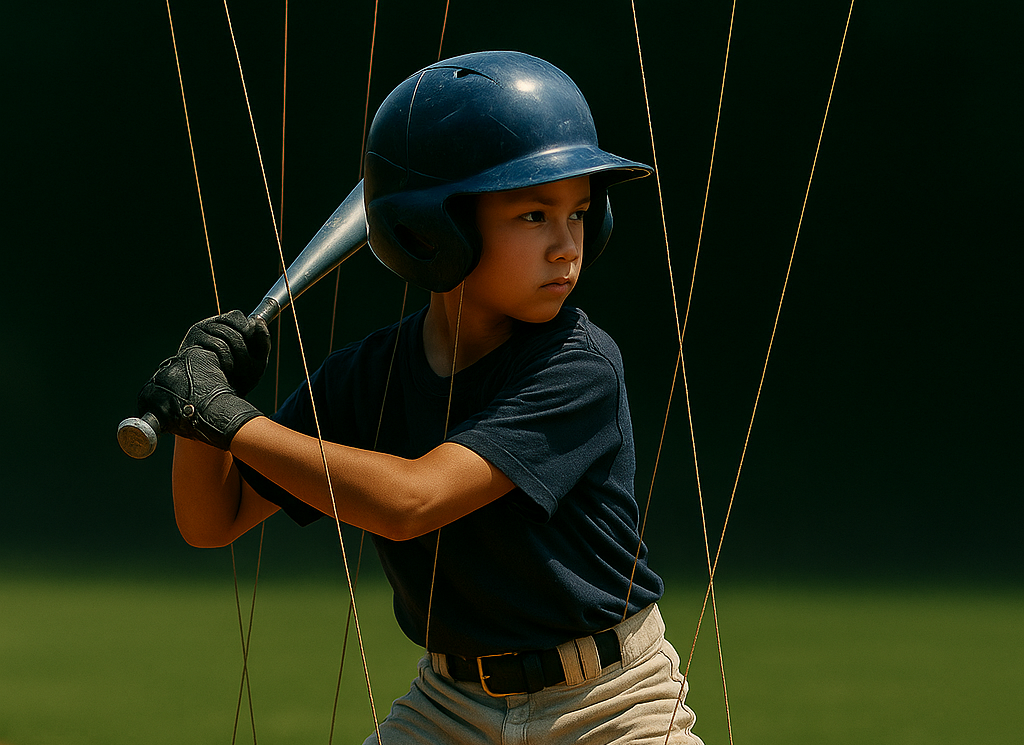
Training tools help guide your swing mechanics - but the magic happens with practice and intention.
There are a million hitting tools out there. Some cost $150. Some cost $1. Some are made in fancy labs. Some are found in your garage next to an old rake and a wiffle ball from 2009.
So how do you know what's worth it?
Let's dive in.
Why Hitting Tools Matter (and Why They Sometimes Don't)
A good tool can highlight a flaw, isolate a movement, or build muscle memory. That's valuable.
But tools aren't magic. They won't turn a kid who swings once a week into a laser-show doubles machine. And sometimes, they confuse more than they help.
So here's the deal: tools are great, when used with intention. You don't need them all. You don't need most of them. But the right one, at the right moment, can make something click.
Categories of Tools (With Examples and Commentary)
🖐 One-Hand Trainers
Great for isolating hands, wrists, and bat control.
- Rawlings Big Stick One-Hand Trainer – feels good, balanced, classic.
- Old 24" tee-ball bat – honestly, this works just as well.
Use it for: One-arm dry swings, tee work, and figuring out what it feels like to stay connected.
🌀 Swing Path Trainers
These help guide the bat through the zone correctly, keeping the hands inside and the barrel on plane.
- Swingrail Swing Path Trainer – a popular strap that teaches connection.
- PVC Inspired Trainer – for shoulder alignment and swing direction.
Use it for: Building a repeatable path and correcting casting or chopping.
🔗 Resistance Bands / Connection Gear
Used to build strength, teach body awareness, and promote staying connected through the swing.
- Swing Disk Swing Feedback Tool – weighted connection to feel where your hands and arms are.
- Bands that connect wrist to hip or elbow to core.
Use it for: Slow, controlled reps. Building that mind-body feel for what "right" feels like.
👁️ Vision & Tracking Tools
Sometimes the swing isn't the problem—it's the eyes.
- Small ball tracking drills
- Colored ball reaction games
- Foam ball toss with numbers
Use it for: Training focus, pitch recognition, and keeping the head still.
🧰 DIY Options (That Actually Work)
- Frisbee: Teaches swing path and rotation.
- PVC pipe: Shoulder alignment and staying on plane.
- Old tee-ball bats: One-hand trainers.
- Pool noodle: Great for obstacle drills or checkpoints.
- Towel drill: Still one of the best for learning how to keep hands inside.
Recommendations + What I Actually Use
Here's what I keep in my bag (and actually pull out):
- 24" tee-ball bat (for one-hand drills)
- Swingrail (sparingly, for older players)
- PVC pipe (great for demo-ing things)
- Wiffle balls
- Heavy Duty Hitting Tee that doesn't tip over every 3 swings
That's it. I've tried others. Some worked for a while. Some didn't. I rotate things in based on the kid, the day, and the vibe.
What Works for One May Not Work for Another
One kid needs to feel the barrel path. Another needs to feel their back elbow. Another needs to just swing as hard as they can until something starts to make sense.
As a coach, your job isn't to find "the" answer. It's to help kids find their answer. As a player, your job is to stay curious, stay open, and stay patient.
The Real Secret: Repetition
Want the truth? Repetition beats innovation.
Whatever tool you choose, use it consistently. Every day if you can. That's when results show up. Not after five reps, but after fifty. After five hundred.
When you find something your player likes—and I mean actually likes, not just tolerates—lean into it. That's where the growth is.
Final Word: Kevin Costner Lost His Swing (and All He Needed Was Love)
In Tin Cup, Kevin Costner's character shanks one into the highway and spirals. He tries every swing aid ever invented. Gadgets. Gimmicks. A hat that beeps when his head moves.
Spoiler alert: None of them work.
You know what does? Getting back to basics. Feeling the swing. Trusting the swing. Loving the swing.
And maybe that's the most important hitting tool of all—belief.
Ready to Find Your Perfect Bat?
Check out our comprehensive reviews of the latest BBCOR bats and find the one that fits your swing.
View BBCOR Bat Reviews